Is Your Merchandising Game In Check For The FIFA World Cup Influx?
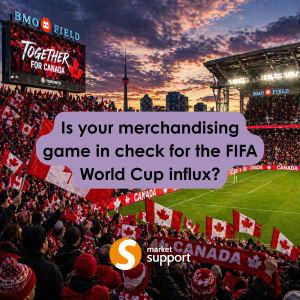 The 2026 FIFA World Cup will bring a level of international attention and tourism to Canada that most retail environments have never experienced at scale. While much of the conversation has centered on national pride, infrastructure, and marketing opportunity, the more immediate impact will be felt inside stores.
This is where demand becomes real.
Canada will host 13 matches, concentrated entirely in Toronto and Vancouver. These two cities will act as primary hubs for international visitors, media, and event-related activity. From a retail standpoint, this creates a highly localized surge in foot traffic that will extend beyond stadiums and into grocery stores, pharmacies, and hardware retailers across both urban and surrounding regions.
For CPG brands, this is not simply an increase in volume. It is a shift in how, where, and why people buy.
Tourism Changes the Rules of Engagement
Retail performance is typically built on predictability. Historical sales data, seasonal trends, and regional behavior patterns inform everything from inventory planning to shelf strategy.
Tourism disrupts that predictability.
Visitors entering the Canadian retail environment during the World Cup will not behave like local shoppers. They are less brand loyal, more time-sensitive, and significantly more influenced by visibility and convenience. Their purchasing decisions are faster, often made in unfamiliar store layouts, and heavily dependent on what is immediately available.
This creates a different kind of pressure on merchandising execution.
If your product is not front-facing, fully stocked, and clearly priced, it is not part of the decision set. Consumers will not search. They will substitute.
This is why FIFA merchandising support needs to be viewed as a strategic layer of execution, not an operational detail.
Toronto and Vancouver Will Absorb the Impact First
The concentration of matches in Toronto and Vancouver means that these markets will experience sustained, high-density retail traffic over a defined period.
This is not a single-day spike. It is a multi-week compression of demand.
For brands operating in these environments, execution cannot be left to chance. Partnering with a premium merchandising company in Toronto or premium merchandising company in British Columbia ensures that shelf conditions are actively managed during peak demand periods.
Downtown cores, suburban retail corridors, and even secondary markets surrounding these cities will feel the impact. Hotels, transit routes, and tourism patterns will push visitors into a wide range of retail environments, many of which are not typically exposed to international consumer behavior at this scale.
For brands, this creates both opportunity and risk.
Opportunity, because more people in store means more potential transactions.
Risk, because execution gaps are amplified under high-traffic conditions.
A shelf that sits empty for a few hours during a normal week may go unnoticed. During the World Cup, that same gap could represent hundreds of lost purchases.
The Radius Effect Across Canada
While Toronto and Vancouver are the epicenters, the impact will not remain contained.
Demand will radiate outward.
Visitors will travel between cities, stay in surrounding regions, and shop along transit corridors. Retailers outside core markets will experience increased traffic, often without the same level of preparation.
This creates a national execution challenge.
Brands operating across provinces must ensure that merchandising standards are consistent, even as demand patterns shift.
Working with a premium merchandising company in Ontario combined with a premium merchandising company in Alberta allows brands to maintain execution consistency across high-impact regions.
Without structured support, execution will vary. And where execution varies, so do results.
Shelf Availability Becomes the Deciding Factor
At its core, retail success during the World Cup will come down to a simple question.
Is your product available when the customer is ready to buy?
Increased traffic accelerates inventory turnover. Products that typically move at a steady pace can sell out quickly, especially in high-visibility categories tied to social gatherings, convenience, and impulse purchases.
The challenge is not always supply. In many cases, inventory exists within the store but is not brought forward in time.
This is where field merchandising teams create measurable impact.
By actively monitoring shelf conditions, pulling stock from backrooms, and ensuring continuous availability, they close the gap between supply and visibility. Without this intervention, brands lose sales despite having the product in the building.
Brands leveraging a premium merchandising company in Ontario or premium merchandising company in British Columbia ensure that availability is actively managed, not assumed.
Pricing and Planogram Discipline Under Pressure
High-traffic environments expose weaknesses in execution.
Pricing discrepancies become more visible and more costly. Visitors, unfamiliar with local pricing norms, rely on clear and consistent cues. Any mismatch between shelf pricing and expectation introduces friction that can lead to lost sales.
Planogram compliance faces similar challenges.
Stores under pressure often deviate from intended layouts. Products are moved, shelves are reorganized, and visibility can be compromised. During normal periods, these deviations may have a limited impact. During the World Cup, they directly affect conversion.
Maintaining discipline in both pricing and placement requires ongoing verification.
Brands operating in dense markets benefit significantly from partnerships with a premium merchandising company in Mississauga, where retail concentration and traffic volume demand constant oversight.
Competitive Pressure Will Intensify
Increased traffic does not create a neutral environment. It heightens competition.
Every brand in the category is working toward the same goal, capturing as much of the incremental demand as possible. This means better shelf positioning, faster replenishment, and stronger compliance.
If your execution falls short, even briefly, competitors will capture that demand.
This is particularly relevant in categories where substitution is easy and brand loyalty is low. Under these conditions, the brand that is present wins.
Scaling Execution Where It Matters Most
National coverage is important, but during the World Cup, prioritization becomes critical.
Execution should be concentrated where impact is highest.
Toronto and Vancouver require intensified focus, supported by surrounding regions that will absorb secondary demand. This is not a time for evenly distributed effort. It is a time for targeted, high-intensity execution.
This is where coordinated regional support becomes essential. Combining efforts from a premium merchandising company in Toronto with broader national coverage ensures that execution holds under pressure.
The Cost of Being Unprepared
The upside of increased traffic is obvious. More people, more transactions, more revenue potential.
The downside is less visible but equally significant.
Missed sales during peak periods are rarely recovered. Consumers who cannot find your product will choose an alternative, and that choice can extend beyond a single purchase.
Additionally, marketing investments tied to the World Cup lose effectiveness if in-store execution does not support them. Awareness without availability does not convert.
From a leadership perspective, this is where alignment becomes critical. Marketing, supply chain, and merchandising must operate as a unified system.
Final Thoughts
The FIFA World Cup will bring unprecedented tourism to Canada, with Toronto and Vancouver at the center of that activity.
Retail environments will see increased traffic, faster turnover, and a broader mix of consumers than usual.
For CPG brands, this is a rare opportunity to capture incremental revenue at scale.
But only if execution is aligned.
FIFA merchandising support is not about maintaining standards. It is about adapting to a different operating environment where visibility, availability, and accuracy determine outcomes.
Because when more people walk into stores, the brands that are ready will win.
And the ones that are not will not be part of the decision.
If you are looking to ensure your brand is fully prepared for this level of retail demand, visit www.marketsupport.ca to see how a premium merchandising partner can help you scale in-store execution across Canada.
« Back to Blog