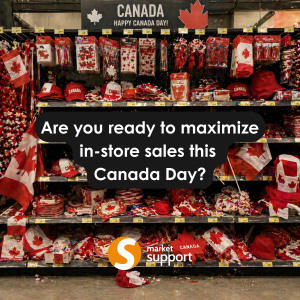
Are You Ready To Maximize In-store Sales This Canada Day?
 Canada Day has a way of compressing retail activity into a short, intense window. Consumers are preparing for gatherings, travel, and time off, and that behavior translates directly into increased store visits across grocery, pharmacy, and hardware retail environments.
From a planning perspective, this is one of the more predictable moments in the Canadian retail calendar. Brands can anticipate demand, align promotions, and ensure product is flowing into stores ahead of the holiday.
Yet despite that predictability, performance during Canada Day often varies significantly between brands that should, on paper, be equally positioned.
The difference is rarely strategy.
It is execution.
Traffic Does Not Guarantee Conversion
An increase in foot traffic is only valuable if it translates into purchases.
During Canada Day, stores are busier, baskets are larger, and purchasing decisions are made more quickly. Customers are not browsing in the traditional sense. They are shopping with intent, often under time pressure.
This creates a narrow window for conversion.
If a product is not immediately visible, available, and clearly priced, it is unlikely to be purchased. Customers will default to what is in front of them, not what they intended to buy before entering the store.
This is why brands that focus on execution outperform those that rely solely on demand generation.
The Importance of Timing in Shelf Readiness
One of the more subtle challenges with Canada Day is timing.
Demand does not spike evenly. It builds in the days leading up to the holiday, peaks just before, and then drops off sharply. This creates a short period where shelf readiness is critical.
If products are stocked too early without proper rotation, they risk being displaced. If they arrive too late, the peak demand window is missed entirely.
Execution during this period requires coordination and responsiveness.
Teams need visibility into what is happening at the store level, not just what was planned at the head office level. This is where merchandising support becomes a differentiator.
Brands that have structured support in place are able to adjust in real time, ensuring that shelves remain aligned with demand as it evolves.
High-Velocity SKUs Require Active Management
Canada Day drives demand in specific categories. Products associated with gatherings, convenience, and seasonal use see accelerated movement.
The challenge is not identifying these SKUs. It is managing them effectively.
High-velocity products can sell through quickly, creating gaps on the shelf even when inventory is available in-store. Without active intervention, these gaps persist longer than they should, leading to lost sales.
Effective merchandising ensures that these products are continuously replenished, prioritized, and positioned for visibility.
In high-density retail markets, even a short lapse in availability can represent a meaningful revenue loss.
Store-Level Variability Increases During Peak Periods
Another factor that often goes underappreciated is how much variability increases during high-traffic periods.
Retail staff are managing more customers, more inventory, and more operational complexity. Under these conditions, execution standards can slip.
Planograms may not be followed precisely. Products may be stocked in incorrect locations. Promotional displays may not be set up as intended.
These issues are not the result of negligence. They are the result of pressure.
From a brand perspective, however, the impact is the same. Reduced visibility, inconsistent presentation, and missed opportunities.
This is where having external merchandising support creates stability. It ensures that execution standards are maintained even when store conditions are less predictable.
Pricing Clarity Becomes More Important
During Canada Day, purchasing behavior accelerates.
Customers are making faster decisions, often with less comparison. In this environment, pricing clarity plays a critical role.
If pricing is unclear or inconsistent, it introduces hesitation. That hesitation can quickly lead to substitution or abandonment.
Ensuring that pricing is accurate and aligned across locations is not just about compliance. It is about removing friction from the purchase process.
Even small inconsistencies can have an outsized impact when multiplied across high volumes of traffic.
The Role of Placement in Driving Incremental Sales
Placement becomes even more important during peak periods.
Secondary displays, end caps, and high-traffic shelf positions have a disproportionate impact on sales when store traffic increases.
However, these placements are also more vulnerable to disruption.
Products can be moved, displays can be altered, and visibility can be reduced as stores adjust to increased activity.
Maintaining placement requires active oversight.
Brands that rely on passive execution often see their positioning degrade over time. Brands that invest in maintaining placement are able to capture a greater share of incremental demand.
Regional Execution Still Matters
While Canada Day is a national event, its impact is not uniform.
Urban centers, suburban markets, and transit corridors all experience different demand patterns. Some regions see earlier spikes. Others experience extended purchasing windows.
Maintaining consistency across these variations requires coordination.
This is where targeted support becomes valuable.
For example, brands working with a premium merchandising company in Ontario can ensure that execution remains consistent across one of the most active retail regions in the country, while still adapting to local store conditions.
The key is not to overextend coverage, but to apply it where it has the greatest impact.
Execution is the Multiplier
Marketing creates demand. Promotions create urgency. Distribution ensures availability at a macro level.
Execution determines how much of that demand is actually captured.
This is why merchandising should be viewed as a multiplier.
When execution is strong, every other investment performs better. Marketing converts more efficiently. Promotions drive higher returns. Inventory moves faster.
When execution is weak, those same investments underperform.
This relationship becomes more visible during peak periods like Canada Day, where the difference between strong and weak execution is amplified by volume.
What Prepared Brands Do Differently
Brands that consistently perform well during Canada Day tend to approach execution differently.
They do not assume that stores will maintain standards under pressure. They plan for variability.
They prioritize high-impact SKUs and ensure they are continuously available.
They monitor pricing and placement, not just at the start of the period, but throughout it.
They align merchandising with marketing and supply chain, ensuring that all three functions support each other.
Most importantly, they treat execution as a strategic function, not an operational detail.
Closing Perspective
Canada Day will bring increased traffic into stores across the country. That part is predictable.
What is less predictable is how much of that traffic your brand will convert.
Execution is where that outcome is decided.
Availability, visibility, pricing, and placement are not background considerations. They are the factors that determine whether demand turns into revenue.
If your objective is to truly maximize in store sales during peak retail moments, it starts with ensuring that execution holds under pressure.
To see how leading brands are strengthening their in-store performance across Canada, visit www.marketsupport.ca and explore how structured merchandising support can drive measurable results.
« Back to Blog