Your Secret Weapon Is Your Merchandising Support
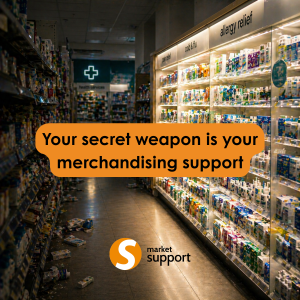 There is a persistent belief in the CPG industry that growth is primarily driven by marketing, pricing strategy, and distribution reach. These are all critical levers, but they share one common limitation. They operate upstream from the moment that actually matters.
The moment a customer stands in front of a shelf and decides what to buy.
At that point, brand awareness, campaign spend, and even loyalty can quickly become secondary to something far more immediate. Availability, visibility, and clarity.
This is where merchandising support becomes the most underappreciated driver of revenue, and in many cases, the most controllable lever for improving performance without increasing spend.
The Disconnect Between Strategy and Execution
Most organizations are well-structured when it comes to strategy. Marketing teams build demand, often supported by significant budgets and sophisticated targeting. Sales teams secure listings and negotiate placement. Supply chain ensures product moves efficiently into distribution networks.
On paper, everything aligns.
The breakdown happens inside the store, and it is rarely visible at the executive level.
Products are not always on the shelf. Pricing can be inconsistent across locations. Planograms are not followed precisely. Displays are missed or implemented incorrectly. Inventory sits in the backroom while shelves remain empty.
These are not isolated issues. They are systemic, and they scale with the size of your retail footprint.
This is exactly where a premium merchandising company becomes critical. Execution is no longer left to chance or stretched retail staff. It is actively managed, measured, and optimized.
Visibility is Not Guaranteed
There is a common assumption that once a product is listed and delivered, it will naturally be visible to customers.
In reality, visibility is one of the most fragile aspects of retail performance.
Shelves are dynamic environments. Products are constantly being moved, replaced, or deprioritized. Retail staff are balancing multiple priorities, and maintaining perfect planogram compliance is rarely at the top of their list.
This creates a gap between intended placement and actual visibility.
For brands operating in dense retail markets, this gap becomes even more pronounced. In cities like Toronto, where store traffic is high and shelf competition is intense, even small deviations in placement can significantly impact sales.
Working with a premium merchandising company ensures that visibility is not left to chance. It is monitored, corrected, and maintained continuously.
Availability is a Moving Target
Out-of-stocks remain one of the most direct and preventable causes of lost revenue.
However, the root cause is often misunderstood.
In many cases, the issue is not supply. It is execution.
Inventory is sitting in the backroom. Cases have been delivered but not unpacked. Products that should be on the shelf are simply not there.
From the customer’s perspective, the reason does not matter. The product is unavailable, and the decision is made instantly to purchase an alternative.
In high-volume retail corridors like the Greater Toronto Area, this becomes a compounding issue. Increased traffic accelerates depletion, and without active replenishment, shelves remain empty for longer periods.
Brands working with a premium merchandising company in Mississauga are able to close this gap. Stock is brought forward, shelves are replenished, and availability reflects actual inventory levels.
This is not just operational efficiency. It is direct revenue protection.
Pricing Accuracy Drives Conversion
Pricing is often treated as a strategic decision made at the corporate level, but its effectiveness is entirely dependent on execution at the shelf.
Discrepancies between system pricing and shelf labels create friction. That friction reduces conversion.
Customers rely on quick, clear signals when making purchasing decisions. If the price is unclear, inconsistent, or incorrect, hesitation increases. In many cases, the purchase is abandoned altogether.
This becomes even more critical during promotional periods or high-traffic events, where pricing clarity directly influences purchasing speed.
In competitive markets across premium merchandising company territories, consistent pricing verification is not optional. It is a fundamental component of protecting revenue.
Planogram Compliance is a Revenue Lever
Planograms are designed using data, insights, and category expertise. They are built to maximize visibility, optimize adjacency, and drive sales.
However, their effectiveness is entirely dependent on execution.
When planograms are not followed, products lose their intended positioning. Cross-sell opportunities are disrupted. High-margin items may be placed in low-visibility areas. The entire strategy breaks down at the shelf level.
Many organizations treat planogram compliance as a passive expectation. Something that should happen naturally.
In reality, it requires active enforcement.
Brands that leverage a premium merchandising company ensure that planograms are not just implemented, but maintained over time, even in high-traffic and high-variability environments.
The Competitive Reality Inside Stores
Retail competition is not abstract. It happens at the shelf, in real time.
If your product is out of stock, a competitor wins the sale. If your placement is compromised, a competitor gains visibility. If your pricing is unclear, customers move to alternatives.
These shifts are immediate and often invisible at the corporate level.
A brand may see stable distribution numbers and assume performance is consistent, while in reality, execution gaps are eroding market share at the store level.
Merchandising support acts as your presence inside the store, ensuring that these competitive dynamics are actively managed.
It is not just about maintaining your position. It is about defending it.
Scaling Execution Across Canada
One of the greatest challenges for national brands is consistency.
Execution quality can vary significantly across regions, retailers, and individual store locations. This variability creates uneven performance and limits the ability to scale success.
Maintaining consistent standards across markets like Ontario and British Columbia requires more than guidelines and training materials.
It requires structured, on-the-ground support.
A premium merchandising company allows brands to standardize execution while adapting to local retail dynamics.
This is how consistency becomes scalable.
From Cost Center to Growth Driver
One of the most important shifts leadership teams can make is redefining how merchandising support is viewed.
Traditionally, it has been categorized as a cost center. A necessary operational expense required to maintain baseline performance.
This perspective limits its impact.
When viewed correctly, merchandising support becomes a growth driver.
Improving availability, visibility, pricing accuracy, and compliance directly increases conversion rates. These improvements may seem incremental at the store level, but when applied across hundreds or thousands of locations, they generate significant revenue gains.
This is one of the few areas in retail where performance can be improved without increasing demand generation spend.
The Alignment Challenge
Merchandising does not operate in isolation. Its effectiveness depends on alignment with marketing, sales, and supply chain. Marketing creates demand. Sales secures placement. Supply chain delivers product.
Merchandising ensures that everything comes together at the point of purchase. Without that final layer, the system remains incomplete. This is why organizations that treat merchandising as a strategic function consistently outperform those that treat it as an operational necessity.
In modern retail, growth is not just about doing more. It is about executing better.
Merchandising support ensures that your product is available, visible, and correctly presented at the moment that matters most.
That is not a background function. It is a competitive advantage.
If you are looking to turn execution into a measurable driver of growth, visit www.marketsupport.ca to see how a premium merchandising partner can help you scale in-store performance across Canada.
« Back to Blog