Retail Merchandising Insider: Maximizing Profitability During Back to School
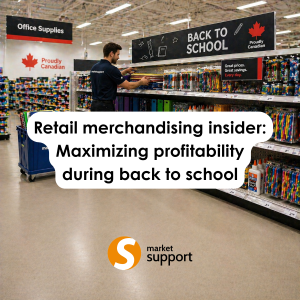 Back to school is one of the most commercially significant periods in the retail calendar. It combines predictable demand with a compressed purchasing window, creating an environment where volume increases quickly and competition intensifies just as fast.
For many brands, this period delivers strong top-line performance. Sales increase, inventory moves, and promotional activity drives traffic into stores. On the surface, it looks like a success.
The challenge is that volume does not always translate into profitability.
Margins are often compressed during back to school due to discounting, promotional pressure, and operational inefficiencies that emerge under increased demand. The brands that outperform during this period are not simply the ones that sell more. They are the ones that execute more effectively.
Where profitability is gained and lost
Profitability during back to school is influenced by a series of small decisions that take place at the store level. While pricing strategy and promotional planning play an important role, execution ultimately determines how efficiently those strategies convert into margin.
Products that are not on the shelf do not generate revenue, regardless of how well they were forecasted. Promotions that are not properly implemented fail to deliver their intended return. High-demand SKUs that are not replenished quickly enough create missed opportunities that cannot be recovered once the purchasing window closes.
At the same time, overstocking slower-moving items ties up capital and reduces overall efficiency. Shelf space becomes diluted, and the balance between high-velocity and low-velocity products begins to shift in a way that impacts both sales and margin.
These are not isolated issues. They are interconnected, and they are all influenced by merchandising execution.
The importance of SKU prioritization
Back to school demand is not evenly distributed across all products. Certain SKUs experience a significant increase in velocity, driven by seasonal needs, convenience, and purchasing habits tied to preparation.
The ability to identify and prioritize these SKUs is critical, but identification alone is not enough. The real challenge is ensuring that these products remain available, visible, and properly positioned throughout the peak period.
Without active management, shelves can quickly become misaligned with demand. High-performing products sell out, while lower-performing items continue to occupy space. This imbalance reduces overall efficiency and limits the ability to maximize revenue per square foot.
Retail merchandising plays a key role in maintaining this balance. By ensuring that priority SKUs are consistently replenished and given appropriate visibility, brands can align shelf performance with actual demand patterns.
Managing inventory under pressure
Increased volume places additional strain on inventory systems.
Replenishment cycles need to be faster. Stock needs to move from the backroom to the shelf more efficiently. Any delays in this process become more costly as demand accelerates.
One of the more common issues during back to school is the disconnect between inventory availability and shelf availability. Products may be present in the store, but not in the right place at the right time.
From a profitability perspective, this creates a gap between potential and actual performance.
Closing that gap requires visibility and responsiveness. Merchandising support provides both, ensuring that inventory is actively managed rather than passively assumed to be available.
The role of pricing execution in margin protection
Promotions are a central part of back to school strategy, but they also introduce complexity.
Discounts need to be clearly communicated. Pricing needs to be consistent across locations. Any discrepancies can lead to confusion, hesitation, or missed conversions.
At the same time, pricing errors can erode margin directly. Incorrect labels, outdated promotional signage, or inconsistent application of discounts all contribute to inefficiencies that impact profitability.
Ensuring pricing accuracy is not just about compliance. It is about protecting margin during a period where every percentage point matters.
Merchandising teams play a critical role in verifying pricing execution and ensuring that promotional strategies are implemented as intended.
Shelf space as a driver of efficiency
Shelf space becomes even more valuable during high-demand periods.
The allocation of that space directly influences which products are seen, considered, and ultimately purchased. When space is not aligned with demand, efficiency declines.
For example, if high-velocity items do not have sufficient facings, they are more likely to sell out quickly, creating gaps that reduce sales. At the same time, low-velocity items may occupy more space than they justify, limiting the overall productivity of the shelf.
Optimizing shelf space is not a static exercise. It requires continuous adjustment based on real-time conditions.
Retail merchandising ensures that these adjustments are made, maintaining alignment between shelf allocation and demand.
Reducing waste and inefficiency
Profitability is not only about increasing revenue. It is also about reducing waste.
During back to school, inefficiencies can take several forms. Overstocked products may not sell through, leading to markdowns. Poor execution can result in missed promotions or underperforming displays. Inconsistent replenishment can create both stockouts and excess inventory.
Each of these issues impacts the bottom line.
By improving execution, brands can reduce these inefficiencies. Products move more predictably. Shelf space is used more effectively. Promotional activity delivers a stronger return.
Over time, these improvements contribute to more sustainable profitability.
The operational reality at store level
It is important to recognize the conditions under which retail staff are operating during back to school.
Stores are busier. Workloads increase. Priorities shift toward managing customer flow and maintaining overall operations.
Under these conditions, execution standards can become more difficult to maintain.
Planograms may not be followed precisely. Replenishment may be delayed. Displays may not be set up as intended.
These are not failures of intent. They are the result of increased pressure.
This is where external merchandising support provides stability. It ensures that execution remains consistent, even when store conditions are less predictable.
Aligning merchandising with broader strategy
Back to school performance is influenced by multiple functions.
Marketing drives awareness and traffic. Sales ensures placement and distribution. Supply chain manages inventory flow.
Merchandising connects these functions at the point of purchase.
When execution is aligned with strategy, each function reinforces the others. Demand generation leads to conversion. Inventory translates into sales. Promotions deliver measurable returns.
When execution is misaligned, the system becomes less efficient.
This alignment is what allows brands to move from volume-driven performance to profitability-driven performance.
What high-performing brands focus on
Brands that consistently maximize profitability during back to school tend to approach execution with a high level of discipline. They prioritize high-impact SKUs and ensure they are consistently available.
They monitor pricing and promotional execution closely, reducing the risk of margin erosion. They treat shelf space as a strategic asset, adjusting allocation based on demand rather than maintaining static layouts. They invest in execution support to ensure that strategy is reflected consistently across stores. Most importantly, they recognize that profitability is influenced as much by execution as it is by planning.
Back to school is a period where performance is amplified.
Strong execution leads to stronger results. Weak execution becomes more visible and more costly. While volume is important, profitability is determined by how effectively that volume is captured and converted.
Retail merchandising plays a central role in that process, ensuring that availability, visibility, pricing, and placement are aligned with demand.
For brands looking to improve profitability during peak retail periods, the opportunity often lies in execution.
To see how structured merchandising support can help improve in-store performance and drive more efficient growth, visit www.marketsupport.ca and explore how a premium merchandising partner can support your retail strategy across Canada.
« Back to Blog