Fewer Stockouts, Better Shelves: How Technology is Changing Retail Replenishment
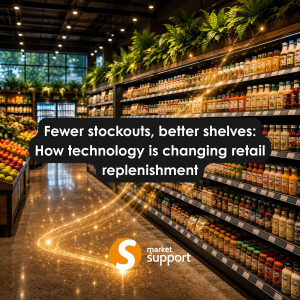 A customer standing in front of an empty shelf does not know whether additional product is sitting twenty metres away in the stockroom, delayed somewhere in the supply chain or waiting to be ordered. From the shopper’s perspective, the situation is much simpler: the product they intended to buy is not available.
That moment illustrates one of the persistent challenges of retail execution. Inventory can exist somewhere within the system without being available where it ultimately generates a sale. For manufacturers, distributors and retailers, improving product availability therefore requires more than getting inventory into a store. It requires an effective connection between inventory, replenishment and the people responsible for making sure products reach the shelf.
This is an area where technology is creating new opportunities for retail merchandising programs. Marketsupport has invested in operational technology that allows our field teams and managers to connect more of the information surrounding store execution, ordering and inventory management.
The objective is straightforward: give the people physically servicing stores better infrastructure so they can execute more effectively and help clients understand what is happening across their retail programs.
A stockout is not always an inventory problem
When people hear the word stockout, the natural assumption is that the store has run out of product. Sometimes that is exactly what has happened, but an empty shelf can have several causes.
Product may be available in the back room but not yet stocked. Inventory records may not accurately reflect what is physically available. Demand may have increased more quickly than anticipated. An order may not have been placed at the right time, or a delivery may not yet have arrived. The store may also be dealing with staffing or operational constraints that have delayed replenishment.
For a manufacturer, those distinctions matter because each situation requires a different response. Sending more product to a store that already has inventory sitting in the back room does not necessarily solve the immediate shelf problem. Likewise, repeatedly stocking the shelf cannot solve an underlying inventory shortage if there is no additional product available.
This is one reason physical field execution remains so valuable. A merchandiser working inside the store can see conditions that may not be apparent from centralized inventory or sales information alone.
Marketsupport’s in-store shelf stocking teams can perform the physical work required to move available products onto shelves while also operating within a more connected system that helps the broader program understand store-level activity.
On-shelf availability is where supply meets execution
Manufacturers invest heavily in making products available to retailers. Forecasting, production, transportation, distribution and inventory management all contribute to getting products into the retail environment, but the final stages of execution remain critical.
A product sitting in a stockroom is inventory. A product sitting on a shelf where a customer can purchase it has an opportunity to become revenue.
Retail replenishment helps bridge that gap.
This makes shelf stocking more strategically important than it can sometimes appear from outside the industry. The physical act may seem simple, but when it is multiplied across hundreds or thousands of stores, the effectiveness of replenishment can influence product availability throughout an entire retail network.
The challenge becomes particularly significant for brands that cannot depend exclusively on store personnel to maintain the level of shelf execution they require. Retail employees are responsible for numerous departments, products and customer needs, while manufacturers are naturally focused on the performance of their own brands.
A dedicated merchandising team provides another layer of support by placing people in stores specifically to execute the client’s program.
When those field teams are supported by better technology, the value of each visit can extend beyond the immediate stocking task.
Technology can connect what the merchandiser sees with what happens next
A merchandiser may arrive at one store and find sufficient inventory available for replenishment, while another location may have little product available to stock. A third store could have an entirely different issue affecting availability.
Historically, the difficulty has been connecting those individual store experiences to the broader operation in a way that allows useful information to move efficiently.
Marketsupport’s technology investment gives us stronger infrastructure for managing field activity and connecting it with other operational functions. Depending on the program, that can include inventory management and ordering capabilities in addition to the physical merchandising work performed inside the store.
The benefit is not that technology suddenly solves every stockout. Retail operations involve numerous organizations and variables, many of which are outside the control of a merchandising partner. The benefit is that field execution can become less isolated from the processes surrounding it.
If a representative identifies an inventory requirement within a program where Marketsupport is supporting ordering, that information can move into the appropriate process. If inventory is available but the shelf needs attention, the field team can perform the physical replenishment work. When patterns begin appearing across locations, better operational visibility can help managers recognize that the issue may extend beyond an individual store.
Technology becomes useful because it helps connect the observation with the appropriate action.
The back room remains an important part of shelf availability
One of the more frustrating retail scenarios occurs when a customer encounters an empty shelf even though product is physically present elsewhere in the store.
From a manufacturer’s perspective, this represents a particularly preventable form of lost opportunity. The product has already moved through much of the supply chain and reached the location, but the final movement from back-room inventory to the shelf has not happened at the right time.
Dedicated shelf stocking support can help address this gap by ensuring there are people in stores focused on the client’s products and merchandising requirements.
This becomes increasingly valuable when manufacturers operate across large retail networks. It is difficult for a centralized brand team to know the exact condition of every shelf at every moment, and retailers must allocate their own employees according to broader store priorities.
A field merchandising partner provides manufacturers with a physical presence at store level. The representative can work with the inventory available, stock products and help maintain execution according to the requirements of the program.
Marketsupport’s expanded operational infrastructure strengthens that model because the field visit can be managed as part of a larger program rather than as an isolated stocking assignment.
Replenishment gets more complicated at scale
Keeping one shelf stocked is not a complex business model. Keeping products appropriately stocked across hundreds or thousands of locations is an entirely different operational challenge.
Each store has its own sales patterns, inventory conditions and operating environment. Even locations belonging to the same retailer can behave differently because consumer demand varies by geography, demographics, seasonality and local circumstances.
A manufacturer therefore needs a field program capable of managing variation without losing consistency.
This is where the combination of people and technology becomes particularly important. Field representatives provide the local presence required to understand individual store conditions, while centralized systems help organize activities across the larger network.
Without the field team, an organization can have excellent data but limited ability to physically correct what is happening on the shelf. Without appropriate technology and operational infrastructure, a large field workforce can become difficult to coordinate and the information generated through store visits can remain fragmented.
Bringing those components together creates a more scalable approach to replenishment.
Better replenishment protects more than an individual sale
The immediate consequence of an unavailable product is obvious: a customer may not be able to purchase it. The broader impact can be more complicated.
Depending on the category, a shopper may choose another size or variation of the same brand, but they may also purchase a competing product. If availability problems become frequent, repeated substitution can potentially influence future purchasing behaviour.
Brands also invest significantly in generating demand before a shopper ever reaches the shelf. Advertising, promotions, digital marketing, packaging and retailer relationships all contribute to creating the purchase opportunity. Poor on-shelf availability can undermine that investment at the final point of conversion.
This is why retail execution deserves to be considered as part of the broader commercial strategy rather than simply an operational expense.
Shelf stocking cannot create demand by itself, and merchandising teams cannot control every factor affecting inventory. What they can do is help protect the opportunity that already exists by making sure available product reaches the place where consumers expect to find it.
Technology can strengthen that effort by giving the field operation better information and creating clearer connections to inventory and ordering processes where those services form part of the program.
The goal is not more technology in the store
Retailers and manufacturers have access to an enormous range of technologies, and adding another platform does not automatically improve execution.
The question should be whether the technology makes the physical operation work better.
For Marketsupport, our investment in technology is designed to strengthen the work our teams already perform in stores. Our merchandisers still need to walk the aisles, work with available inventory and stock shelves. The technology behind them helps us manage those activities across a larger network and creates opportunities to connect field execution with inventory, ordering and other operational processes.
This distinction matters because retail merchandising is fundamentally a physical business. Consumers purchase physical products from physical shelves, and someone needs to ensure those products are available.
Technology is valuable when it helps the people responsible for that work perform it more effectively.
A better shelf starts with a better-connected process
There is no single solution to retail stockouts because there is no single cause. Product availability is influenced by forecasting, production, distribution, retailer operations, inventory accuracy, ordering, replenishment and store-level execution.
What manufacturers can do is strengthen the connections between the parts of that process they are able to influence.
Marketsupport’s role begins with having experienced people physically present in stores to perform the shelf stocking and merchandising work our clients require. Our new technology capabilities allow us to support those people with stronger operational infrastructure and, where appropriate, connect field activity with inventory management and ordering.
That creates a more complete approach to retail replenishment. Instead of viewing the store visit as the final isolated step in the process, it becomes part of a connected system designed to move products toward the place where they generate value.
For a shopper, none of that complexity is visible. They simply reach for the product they came to buy.
When the shelf is stocked and the product is there, retail execution has done its job. For more information visit www.marketsupport.ca.
« Back to Blog