Canadian Retail Merchandising Innovator of the Month – Chapmans Ice Cream
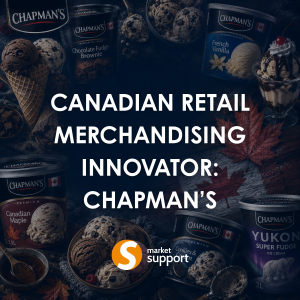 There is something deceptively simple about buying ice cream. A shopper walks into the frozen aisle, opens a freezer door and reaches for the flavour or format they want. Behind that uncomplicated purchase sits one of the more demanding merchandising environments in a supermarket.
Frozen space is finite. Products cannot be moved onto an ordinary shelf when the freezer is full, and a large assortment creates constant competition for the space available. Consumer demand can also change dramatically with weather, seasonality, promotions and new product introductions, while maintaining appropriate inventory requires coordination between production, distribution, store operations and replenishment.
Chapman’s Ice Cream has managed to build extraordinary scale within that environment. The Canadian family-owned company now offers more than 200 products across ice cream, frozen yogurt, sorbet, water ice and single-serve novelties, with products available in every Canadian province and territory.
At the same time, the company continues to innovate. Chapman’s introduced 10 new Canadian-inspired flavours in one product cycle and was named Ice Cream Maker of the Year at the 2025 International Ice Cream Consortium conference, where it also received recognition for Most Innovative Ice Cream and Best Technical Solution.
This combination of assortment, innovation, national availability and operational growth is why Marketsupport has selected Chapman’s Ice Cream as our Canadian retail merchandising innovator of the month.
National availability is an operational achievement
Building a brand that consumers recognize nationally is difficult. Making that brand physically available from one side of Canada to the other introduces an entirely different challenge.
Canada’s geography makes national retail execution particularly demanding. A manufacturer serving every province and territory needs to support markets separated by enormous distances, while individual retailers, stores and regions can have very different requirements.
Chapman’s has built its business exclusively around the Canadian market. Its products are available from coast to coast, and the company provides consumers with a product locator designed to help them identify retailers that typically carry specific Chapman’s products.
That kind of accessibility matters because consumers develop expectations around established brands. When someone has a preferred ice cream flavour, novelty or dietary-specific product, they expect to be able to find it with reasonable consistency.
For manufacturers, achieving that expectation requires much more than getting products accepted by retail chains. Distribution creates the opportunity to be present, while effective retail execution helps turn that opportunity into actual availability.
This distinction becomes especially important when the manufacturer has a large assortment.
More than 200 products create a merchandising challenge
Chapman’s portfolio is notable not simply because of its size, but because of its diversity.
The company offers traditional ice cream alongside frozen yogurt, sorbet and water ice products, while also maintaining ranges designed for different dietary needs. Its portfolio includes lactose-free, gluten-free, peanut-free, nut-free, egg-free and no-sugar-added options, among others.
This breadth allows Chapman’s to serve consumers who might otherwise have relatively limited options within the frozen dessert category. It also creates an assortment challenge because no individual supermarket freezer can necessarily carry every product the company manufactures.
Retail execution therefore involves making choices about which products belong in which environments and then maintaining the availability of those products once the assortment is established.
A high-volume family-size product may behave differently from a premium 500-millilitre tub. Individually wrapped novelties serve another purchasing occasion, while dietary-specific products may attract consumers who are deliberately searching for a particular option.
Each SKU occupies physical freezer space and represents inventory that needs to move.
For growing CPG brands, Chapman’s provides a useful reminder that expanding an assortment can create significant commercial opportunities, but every successful product also adds another layer to the retail execution requirement.
Innovation only matters if the new product reaches the shopper
Chapman’s continues to add new products even with an already extensive portfolio.
Its introduction of 10 Canadian-inspired flavours demonstrates the scale of that innovation. The additions extended several collections, including Original Ice Cream, Frozen Yogurt, Sorbet and No Sugar Added and Lactose Free products. The company said consumer feedback helped inspire the new products, while Canadian ingredients and familiar Canadian flavours influenced the development process.
This is exactly the type of innovation that can generate renewed attention for an established brand. Existing customers have a reason to revisit the freezer, while new flavours and formats create opportunities to reach different consumers.
The retail challenge begins as soon as those products are launched.
Introducing 10 products does not magically create 10 additional spaces in a supermarket freezer. New SKUs need to enter an existing category where other Chapman’s products and competitive brands are already fighting for visibility and availability.
Once those products are authorized and inventory reaches the store, the execution requirement continues. Consumers who have heard about a new flavour need to be able to find it, while stores need sufficient inventory to support demand without overwhelming limited frozen storage capacity.
This is why the connection between product innovation and merchandising deserves more attention. Product teams create the reason to buy, but the retail operation has to make the purchase possible.
Frozen inventory has nowhere else to go
One of the reasons frozen food merchandising is particularly interesting is that the category has a hard physical constraint.
A case of shelf-stable product can sometimes be held in a conventional stockroom until space becomes available on the shelf. Frozen inventory needs appropriate temperature-controlled storage throughout the process.
That changes how stores and manufacturers need to think about inventory.
The amount of product a location can reasonably hold is influenced by both sales-floor freezer capacity and back-room frozen storage. If a fast-moving product is understocked, the store can miss sales. If too much slow-moving inventory occupies limited freezer capacity, it can make the overall category more difficult to manage.
Accurate assortment decisions and effective replenishment therefore become particularly valuable.
The field execution surrounding the category also needs to recognize that an empty freezer position cannot always be solved simply by finding another case somewhere in the store. Inventory availability and physical shelf execution need to work together.
For brands competing in frozen, the ability to maintain dependable availability across a large retail network becomes a meaningful commercial advantage.
Chapman’s is building capacity behind its growth
A company cannot continue expanding its assortment and national presence without investing in the infrastructure required to produce enough product.
Chapman’s has been doing exactly that.
In September 2025, the company announced a major expansion in Markdale, Ontario, involving a new 175,000-square-foot production facility. The project was supported by a $27 million investment from Invest Ontario and is designed to increase production capacity while supporting additional product offerings.
That investment tells an important part of the retail availability story.
Consumers generally experience availability at the end of the process when they see a product in the freezer. The ability to maintain that presence begins much earlier with manufacturing capacity, supply planning and distribution.
A merchandising team cannot stock product that has not been produced or delivered, just as strong manufacturing output does not guarantee that every product will be properly available at store level.
Reliable retail performance requires those functions to work together.
Chapman’s continued investment in Canadian manufacturing gives the company greater capacity to support its product portfolio and future growth. The next challenge is ensuring that increased production continues translating into effective availability across the retail network.
Strong brands still compete every time the freezer opens
Brand recognition creates an advantage, but it does not eliminate competition at the point of purchase.
Frozen aisles contain an enormous variety of products competing for attention, including established national brands, private-label products, premium offerings, value options and increasingly specialized products designed around dietary preferences.
A shopper may enter the aisle intending to purchase Chapman’s but still encounter numerous alternatives within seconds.
Availability therefore remains important even for a well-established brand. If a preferred product is unavailable, frozen desserts are a category where substitution can be relatively easy. A shopper may select another flavour from the same manufacturer, but they can just as easily reach for another brand.
Consistent execution helps reduce the number of occasions when the brand unnecessarily gives a competitor that opportunity.
This is one reason premium retail merchandising should not be viewed as something only emerging brands require. As distribution, assortment and consumer demand grow, the cost of inconsistent execution can grow with them.
Merchandising needs to keep pace with assortment
Large CPG portfolios create a temptation to measure success primarily through distribution. The manufacturer can point to the number of retailers carrying the brand, the number of SKUs listed and the geographic footprint achieved.
Those are important measures, but the consumer experiences something more specific.
They experience one store, one freezer and one shopping trip at a time.
The shopper looking for a particular Chapman’s product does not experience the company’s 200-product portfolio or national distribution network. They experience whether the product they want is available at the location where they happen to be shopping.
This is where field execution becomes the local expression of a national strategy.
Manufacturers need people and processes capable of supporting execution across individual stores while the organization manages the larger retail relationship. As the store network expands, maintaining that local presence becomes increasingly difficult without strong field infrastructure.
Technology can support coordination and visibility, but the physical nature of retail means people still play an essential role in execution.
What other CPG brands can learn from Chapman’s
Chapman’s provides several useful lessons for manufacturers trying to build stronger Canadian retail businesses.
Product innovation should be continuous, but it needs to be supported by the operational capacity required to bring those products to market. A broad assortment can create competitive strength when it addresses meaningful consumer needs, but every additional SKU also needs to earn and maintain its place within a finite retail environment.
National distribution is valuable because it creates access, but the consumer ultimately judges availability at the individual store level. Manufacturing capacity, distribution, inventory management and merchandising therefore need to support one another.
Chapman’s also demonstrates the value of understanding the market it serves. Its Canadian identity is deeply connected to the brand, from using 100 percent Canadian dairy across its real ice cream products to developing flavours inspired by Canadian ingredients and consumer preferences.
That creates a strong brand proposition, but even the best proposition needs execution behind it.
Premium merchandising helps protect national availability
The scale Chapman’s has achieved illustrates exactly why merchandising becomes more important as a consumer brand grows.
A manufacturer can invest in production capacity, develop products consumers want and establish relationships with major retailers across the country. Those accomplishments create an enormous commercial opportunity, but they also create thousands of individual points where retail execution needs to work.
Marketsupport helps brands manage that final physical layer.
Our in-store shelf stocking and retail merchandising teams provide the field presence required to support products across distributed retail networks. Behind those teams, our technology and operational infrastructure help us manage increasingly sophisticated programs involving field execution, inventory and other connected activities.
For brands pursuing the kind of national presence Chapman’s has achieved, choosing a premium merchandising company should be considered part of the infrastructure required to protect that growth. Strong field coverage can help manufacturers maintain execution across large numbers of stores without needing to build and manage the entire workforce internally.
Chapman’s deserves recognition because its story demonstrates that retail innovation is not limited to inventing the next flavour. The company continues developing new products, serving different consumer needs, investing in Canadian manufacturing and making an exceptionally broad portfolio available across the country.
The freezer door is ultimately where all of that work becomes visible to the consumer.
For another CPG brand aspiring to achieve similar scale, the lesson is worth remembering. Producing an excellent product gives consumers a reason to want it, and distribution gives retailers an opportunity to sell it. Consistent, premium retail merchandising helps ensure the product is actually there when the consumer reaches for it.
That final step is where working with a merchandising organization such as Marketsupport can help turn national distribution into dependable retail presence. For more information visit www.marketsupport.ca.
« Back to Blog