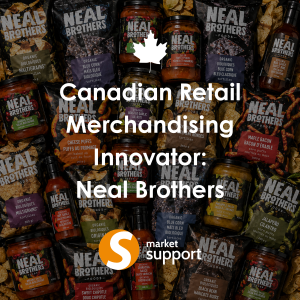
Canadian Retail Merchandising Innovator: How Neal Brothers wins in-store through consistency and execution
 When companies evaluate their growth strategy in consumer packaged goods, the conversation almost always gravitates toward marketing initiatives. There is a natural tendency to believe that increased awareness, stronger campaigns, and greater digital presence will translate directly into increased revenue. While those elements certainly play a role, they often distract from a more fundamental truth about retail performance, particularly within the Canadian market.
Revenue is not ultimately decided in the marketing funnel. It is decided in-store, at the precise moment a consumer reaches for a product and either finds it or does not.
This is what makes Neal Brothers such a compelling example of a Canadian retail merchandising innovator. Their success has not been built on outspending competitors or dominating media channels, but rather on executing the core mechanics of retail with a level of consistency that most mid-market brands struggle to maintain. What they have built is not simply a brand presence, but a reliable system that converts shelf space into predictable sales.
To fully appreciate why this matters, it is important to understand the structural realities of Canadian retail.
The Canadian grocery and pharmacy landscape is highly consolidated, with a relatively small number of national chains controlling the majority of distribution. Retailers such as Loblaw, Sobeys, and Metro operate with a high degree of discipline, and shelf space within these environments is both limited and extremely valuable. Buyers are not incentivized to take risks on brands that show potential but fail to deliver consistently. Instead, they prioritize products that perform reliably across locations, maintain steady inventory levels, and contribute to overall category stability.
What is often missed in this discussion is how buyers actually think. Their role is not to discover the next exciting brand, but to protect category performance. That means minimizing risk, ensuring turnover, and maintaining a predictable customer experience. A product that looks promising but introduces inconsistency, whether through stockouts, erratic demand, or unclear positioning, quickly becomes a liability rather than an asset.
Within this context, Neal Brothers has positioned itself as a dependable partner rather than a speculative bet. This distinction is subtle, but it has a profound impact on merchandising outcomes and long-term shelf presence.
One of the most overlooked aspects of retail merchandising is availability. It is often treated as a logistical concern rather than a strategic one, yet it is arguably the single most important factor in determining whether a product succeeds at shelf level. A well-designed package, a strong brand identity, and even competitive pricing lose their effectiveness entirely if the product is not physically present when the consumer is ready to purchase.
Neal Brothers has clearly recognized this and built its operations accordingly. By maintaining strong fill rates across their core SKUs, they ensure that their products are consistently available in the moments that matter most. This reliability does more than secure individual transactions. It reinforces consumer trust and strengthens the retailer’s confidence in the brand’s ability to perform.
The financial impact of this is often underestimated. An out-of-stock does not simply represent a missed sale in that moment. It creates a chain reaction. The customer substitutes with another product, potentially forming a new habit. The retailer records a lost sale for that SKU, which affects future ordering decisions. Over time, repeated gaps can lead to reduced facings or complete delisting.
When viewed through that lens, availability is not just an operational metric. It is a revenue protection mechanism.
Closely tied to this is Neal Brothers’ approach to SKU management. In many cases, mid-market CPG brands attempt to accelerate growth by expanding their product lines too quickly. New flavors, formats, and variations are introduced in an effort to capture additional shelf space, but this often leads to increased complexity in forecasting, inventory management, and distribution.
Neal Brothers has taken a more disciplined path, focusing on a curated set of products that have demonstrated strong performance. This approach simplifies operations while also concentrating demand into a smaller number of SKUs, which in turn improves turnover rates at the store level. From a merchandising perspective, this creates a cleaner and more effective shelf presence, as retailers can allocate space to products that consistently justify it.
There is also a strategic dimension to this discipline. When a brand limits its portfolio to high-performing items, it becomes easier to build momentum behind those products. Marketing efforts are more focused, retailer support is more consistent, and the brand develops stronger recognition within its category.
At the same time, the brand has maintained a clear and coherent positioning within the category. In a crowded snack aisle where many products compete for attention, clarity becomes a powerful differentiator. Neal Brothers has established itself firmly within the premium, better-for-you segment, and this positioning is reinforced across packaging, pricing, and product formulation.
This consistency allows both retailers and consumers to quickly understand the role the brand plays within the category. For retailers, it simplifies placement decisions and ensures alignment with broader category strategies. For consumers, it reduces decision friction, making it easier to identify the product as a suitable option without requiring additional consideration.
Another critical element of Neal Brothers’ success lies in its approach to distribution. While distribution is often viewed as a backend function, it plays a central role in shaping the in-store experience. A product that is inconsistently available across locations undermines both consumer trust and brand equity, regardless of how strong its positioning may be.
By investing in reliable distribution networks and maintaining strong relationships with retail partners, Neal Brothers ensures that its products are not only listed, but consistently replenished across multiple banners. This creates a sense of ubiquity that reinforces brand recognition and encourages repeat purchasing behavior.
From a merchandising standpoint, this consistency across locations is invaluable. It allows the brand to deliver a uniform experience to consumers, regardless of where they shop, which is a key factor in building long-term loyalty.
What often separates strong retail brands from average ones is their ability to operationalize these principles at scale. It is one thing to design a strategy around availability and positioning, and another to execute it consistently across hundreds or thousands of store locations. This requires alignment across internal teams, distributors, and retail partners, as well as a willingness to prioritize execution over expansion.
Neal Brothers appears to have embraced this reality. Rather than chasing aggressive growth through rapid product expansion or constant reinvention, they have focused on building a system that works reliably and can be scaled without breaking. This type of discipline is less visible than marketing campaigns, but it is far more impactful in terms of long-term performance.
Ultimately, what Neal Brothers has achieved is a frictionless in-store experience. When a consumer enters a store with the intent to purchase a snack, the process of finding and selecting their product is straightforward. The product is easy to locate, clearly differentiated from alternatives, and reliably in stock. There are no barriers or points of hesitation that might disrupt the purchase decision.
This level of execution may not appear innovative in the traditional sense, but in a market where many brands struggle to maintain even basic consistency, it represents a significant competitive advantage.
For other Canadian CPG brands, the lessons are both practical and actionable. Growth is not solely a function of increased marketing investment, but of improved execution at the point of sale. This requires a shift in focus from external visibility to internal alignment, ensuring that supply chain operations, product strategy, and retail partnerships are all working toward the same objective.
It also requires discipline. Not every opportunity to expand should be pursued, and not every trend needs to be adopted. In many cases, the most effective strategy is to refine and strengthen what is already working, rather than introducing unnecessary complexity.
Neal Brothers demonstrates that when these principles are applied consistently, they can produce results that rival or exceed those of much larger competitors. By prioritizing availability, maintaining SKU discipline, and reinforcing clear positioning, they have created a model for retail success that is both scalable and sustainable.
In the end, the distinction between brands that succeed in retail and those that struggle often comes down to execution rather than strategy. Many companies have access to similar insights, tools, and resources, but relatively few are able to translate those into consistent performance at the shelf level.
Neal Brothers has done exactly that, and in doing so, has established itself as a true Canadian retail merchandising innovator. For companies looking to strengthen their position within the market, the path forward is not necessarily more complex, but it does require a higher standard of discipline, alignment, and operational excellence.
« Back to Blog