Canadian Retail Merchandising Innovator of the Month: Oikos
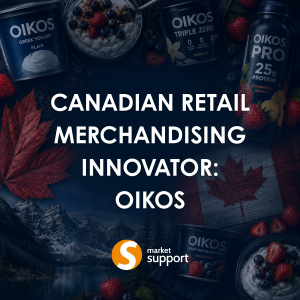 A successful product launch creates a problem every consumer brand should want to have: people start looking for the product.
The harder question is whether the retail operation is prepared for what happens next.
When Oikos introduced its PRO range to Canadian consumers in February 2025, Danone Canada was responding to a significant change in how people were thinking about food and nutrition. The new range offered between 18 and 24 grams of protein per serving, included both traditional tubs and drinkable formats, and was positioned as a first-to-market offering providing the highest-protein yogurt and drinkable yogurt options available on Canadian shelves at launch.
The product was supported by a national marketing campaign across television, online video, out-of-home advertising, public relations, creators and social media. Oikos was not quietly testing another flavour. Danone was creating national awareness around a new proposition within an already competitive refrigerated category.
That is one reason Marketsupport has selected Oikos as a Canadian retail merchandising innovator of the month.
Oikos demonstrates an important reality for consumer brands: product innovation and retail execution eventually have to meet in the same place. You can develop a product around a powerful consumer trend and put significant marketing behind it, but consumers still need to encounter that product in the refrigerator when they are ready to buy it.
Oikos recognized where Canadian demand was moving
The growth of protein-focused food has been difficult to miss, but Oikos moved beyond simply adding the word “protein” to an existing product.
Danone Canada developed Oikos PRO specifically around changing nutritional preferences. The company cited research showing that 71 percent of Canadians wanted to consume more protein and that the number of people identifying protein as the most important nutritional factor in their diet had increased substantially over the previous decade.
The resulting Oikos PRO range was designed around different consumption occasions. It included 650-gram tubs in several flavours along with 300-millilitre drinkable products intended to provide another option for consumers looking for convenient protein.
This is strong product innovation because the brand did not simply identify a trend. It translated that trend into products and formats designed for the way consumers might actually incorporate them into their lives.
However, innovation of this kind immediately creates a merchandising challenge. More formats and more flavours mean more individual products competing for finite refrigerated shelf space. Retailers need to decide where those products belong, consumers need to be able to find them, and inventory needs to move through the store efficiently enough to support the demand being generated.
The commercial success of innovation therefore depends on much more than what happens in product development.
Refrigerated grocery leaves little room for weak execution
Every retail category has operational challenges, but refrigerated products create a particularly unforgiving environment.
A bottle of vitamins or a household product can remain in inventory for considerably longer than many refrigerated foods. Yogurt operates within a different set of constraints because shelf life matters, temperature matters and inventory needs to move.
This changes the importance of replenishment.
If demand is strong but products are not moving efficiently from store inventory onto the shelf, the brand can miss sales while simultaneously dealing with a product category where time is an important factor. If inventory levels are too low, shoppers encounter empty spaces. If the wrong assortment is maintained relative to local demand, slower products can occupy valuable refrigerated space while faster-moving products become unavailable.
Field execution becomes especially important in this type of environment because merchandising is not simply about making a shelf look organized. It is about helping ensure products are physically available in the place where consumers expect to find them.
For Oikos, which now serves consumers across original, lactose-free, lower-sugar and high-protein needs, maintaining a broad assortment creates opportunities while also increasing the complexity of execution.
New products have to earn their place on the shelf
Retail shelf space is valuable, and refrigerated shelf space can be particularly competitive.
When a manufacturer introduces several new SKUs, the retailer is making room for those products within a category that already contains established brands and existing assortments. The manufacturer therefore needs the launch to perform.
Marketing can create the initial interest, but retail execution helps determine whether consumers can translate that interest into purchases.
Consider what happens when someone sees an Oikos PRO advertisement, hears about the product from a fitness creator or decides they want to increase the protein in their breakfast. That consumer may arrive at a grocery store specifically looking for the product.
If they find it, the marketing and retail experience connect exactly as intended. If they cannot find it because the shelf is empty or the product has not been replenished effectively, the brand has created demand without capturing the sale.
The consumer may choose another Oikos product, but they may also choose a competitor.
This is why merchandising should be considered part of the product launch strategy rather than something that happens after the launch has already been planned.
Oikos is backed by serious Canadian production investment
Another reason Oikos stands out is the infrastructure Danone has continued to build behind its Canadian yogurt business.
Oikos products are prepared in Canada using Canadian dairy milk, with production connected to Danone’s Boucherville, Quebec facility. Danone initially invested $40 million in the Boucherville plant for Oikos production in 2013.
The investments have continued as the category has grown.
In 2025, Danone announced a $9 million investment in Boucherville to support new individual yogurt packaging, with Oikos specifically associated with the initiative. Later that year, Danone announced the largest investment it had ever made in Canada to expand the same plant and increase production capacity in response to growing Canadian yogurt demand.
That matters from a merchandising perspective because reliable retail execution ultimately depends on reliable supply.
Shelf stocking cannot solve a production shortage, just as manufacturing more product cannot solve an execution problem inside the store. Strong consumer availability is created by multiple parts of the organization working together, including manufacturing, distribution, retailer relationships, inventory management and store-level replenishment.
Danone’s willingness to invest in additional Canadian capacity demonstrates the infrastructure required when a category and its brands continue to grow.
Innovation creates complexity that needs to be managed
There is an interesting paradox in CPG growth. The more successful a brand becomes at identifying consumer needs, the more complicated its retail execution can become.
A single product is relatively straightforward to manage. A portfolio addressing different nutritional needs, flavour preferences, package sizes and consumption occasions creates considerably more variables.
Oikos offers products for consumers seeking traditional Greek yogurt, high protein, less sugar and lactose-free options. Different formats can also create different purchasing occasions, from a large tub kept at home to a drinkable product designed for convenience.
From a consumer perspective, this variety is valuable because it allows the brand to serve more needs. From an execution perspective, each additional product needs inventory, shelf space and replenishment.
The challenge becomes maintaining choice without allowing the retail environment to become inconsistent.
For manufacturers pursuing a similar strategy, this is where experienced merchandising support can become particularly valuable. Field teams can provide physical execution at store level while helping manufacturers maintain the presence required across a growing assortment.
Marketing and merchandising need each other
The Oikos PRO launch provides a useful example of how significant the connection between marketing and retail execution has become.
Danone supported the range with a national 360-degree campaign designed to reach Canadians across multiple media channels. That level of investment creates awareness before the consumer enters the store.
The retail environment then needs to finish the job.
This is sometimes overlooked because marketing performance and retail execution can be managed by different teams. The marketing organization measures reach, engagement and consumer response, while sales and retail teams focus on distribution and in-store performance.
The consumer does not experience those functions separately. They see an advertisement, develop interest and eventually look for the product.
If the product is there, the experience feels seamless. If it is not, the organizational explanation behind the stockout is irrelevant to the shopper.
For brands spending heavily to create consumer demand, strong merchandising helps protect that marketing investment at the point where purchase becomes possible.
Growth makes availability harder, not easier
Success can create its own execution pressure.
As awareness increases and more consumers purchase a product, inventory needs to move faster through the retail system. Production capacity may need to increase, forecasts need to respond to changing demand and individual stores need to replenish products frequently enough to keep shelves available.
Danone’s decision to expand its Canadian yogurt production capacity provides an indication of the scale involved. The company described growing consumer demand as a reason for its major Boucherville investment.
For a brand, this is an excellent challenge to face, but it reinforces the importance of building operations alongside demand.
A product should not become harder to find because it has become more successful.
Manufacturers need to anticipate how growth will affect every stage between production and the consumer. Field merchandising sits near the end of that chain, but it is one of the stages shoppers experience most directly.
What growing CPG brands can learn from Oikos
The first lesson from Oikos is that meaningful innovation begins with a consumer need. High-protein products were not introduced in isolation. They were developed in response to a measurable shift in what Canadian consumers were looking for.
The second lesson is that innovation needs operational support. New products introduce additional inventory and merchandising requirements, particularly when multiple flavours and formats are launched simultaneously.
The third is that manufacturing, marketing and retail execution need to scale together. Danone is investing in production capacity while continuing to build brands and introduce new products because sustainable growth requires infrastructure behind the consumer proposition.
The final lesson happens inside the store. A product cannot build repeat purchasing if consumers repeatedly struggle to find it.
That may sound obvious, but it becomes much harder to accomplish when a brand operates across a large retail network with numerous SKUs and rapidly changing demand.
Premium merchandising helps innovation perform at retail
Oikos deserves recognition because the brand illustrates how innovation can be connected to a much larger commercial system. Consumer trends inform product development, Canadian manufacturing supports supply, national marketing creates demand and retail execution provides the final connection to the shopper.
Brands hoping to achieve similar results need to consider that complete journey.
Marketsupport specializes in the physical part of retail execution that occurs when products reach stores. Our in-store shelf stocking merchandisers help brands maintain product availability across distributed retail networks, while our technology and operational infrastructure allow us to support increasingly sophisticated programs.
For an innovative CPG brand, a premium merchandising partner becomes particularly important as the assortment and retail footprint grow. New products need attention at store level, fast-moving inventory needs replenishment and the field operation needs enough scale to support demand across numerous locations.
There is a great deal to admire about the product innovation behind Oikos, particularly its willingness to respond to changing Canadian nutritional preferences. What earns the brand our retail merchandising recognition is the larger lesson created by that innovation: growth only becomes commercially meaningful when consumers can reliably find the products being promoted.
For brands working toward that level of retail performance, product development is the beginning of the journey. Strong distribution creates access, marketing generates interest and premium field execution helps make sure the opportunity is not lost at the shelf.
That is where an experienced merchandising company such as Marketsupport can help turn an ambitious retail strategy into consistent execution across the stores where consumers actually make their decisions. For more information visit www.marketsupport.ca.
« Back to Blog