The Next Generation of Premium Merchandising is People + Technology
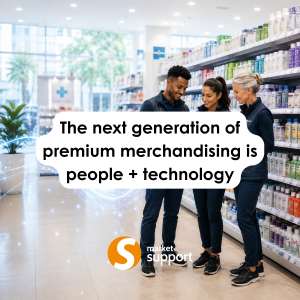 Technology has transformed almost every part of retail, from forecasting and supply chain management to ecommerce, payments and consumer analytics. Yet when a customer walks into a physical store and reaches for a product, there is still an unmistakably human element behind that interaction. Someone had to make sure the product was available, move it onto the shelf and support the physical execution required to keep that part of the store ready for shoppers.
Retail merchandising is therefore an interesting industry to consider in the middle of a much larger conversation about automation. There are certainly processes that technology can automate, but the fundamental work of in-store shelf stocking still requires people to be physically present.
The opportunity is not to find technology that eliminates those people. It is to give them technology that makes every hour they spend in the field more productive and connects their work more effectively to the broader retail operation.
That philosophy is behind Marketsupport’s recent investment in new enterprise technology. We are strengthening the infrastructure that supports our field merchandising teams so that the physical work happening in stores can operate within a more connected environment involving scheduling, field activity, ordering, inventory and other program requirements.
For brands and manufacturers, this represents an important evolution in what they should expect from a retail merchandising partner.
Physical retail creates physical work
It is easy to underestimate how much physical activity sits behind a well-stocked retail shelf.
Products arrive at stores, inventory moves through receiving areas and stockrooms, shelves need replenishment, and conditions can change throughout the day as consumers purchase products. The process is repeated across departments, stores, cities and regions.
Data can indicate that inventory exists at a location, but data cannot physically move a case of product from the stockroom to the shelf. An automated alert can identify that attention may be required, but the alert cannot perform the work itself.
This is why field merchandising remains so important even as retailers and manufacturers adopt increasingly sophisticated technology.
A trained merchandiser provides the physical connection between a brand’s retail strategy and what is actually happening inside the store. They can stock shelves, work with available inventory and encounter real-world conditions that may not be obvious when looking at centralized information.
Technology becomes most valuable when it supports that person rather than attempting to substitute for them.
Productivity is about removing unnecessary work
Making a field team more productive does not mean expecting people to move faster through every store. Sustainable productivity comes from reducing unnecessary administrative work, improving coordination and giving representatives better systems for completing the activities that surround the physical merchandising assignment.
Consider the amount of information that can move around a large field program. Store assignments need to be organized, activity needs to be managed, information from the field may need to reach operational teams, and certain programs may involve inventory or ordering requirements in addition to shelf stocking.
When those activities depend heavily on disconnected processes, representatives and managers can spend time moving information rather than acting on it.
A more integrated technology environment can reduce some of that friction. Information captured through the field process can become part of a structured operational workflow, allowing the organization to coordinate a large number of store visits more effectively.
For Marketsupport, the goal is to use technology to make the overall program more efficient so our people can focus more of their effort on the work clients actually need performed.
A merchandiser can become a more connected part of the operation
Traditionally, it has been easy to think of merchandising as a relatively isolated field activity. A representative receives an assignment, visits the store, performs the required work and reports completion.
That model can accomplish the immediate task, but it does not take full advantage of having a person physically present at the point where inventory, store operations and consumer demand come together.
A more connected field operation creates opportunities for the representative’s activity to support additional processes. Depending on the program, store-level information can contribute to inventory management, replenishment decisions or ordering. Marketsupport can also support automated store orders for Direct Store Delivery programs, allowing representatives to take orders that move through our system into the appropriate ordering workflow.
The important change is not that the merchandiser suddenly becomes responsible for every aspect of retail operations. It is that the work happening in the store can connect more effectively with other activities when the program requires it.
This makes the field team a more integrated extension of the manufacturer’s retail operation rather than a separate resource completing individual assignments.
Technology becomes increasingly important as programs scale
A retail merchandising program operating across a limited number of locations can often rely on relatively simple processes. The operational requirements change considerably when the same program expands across a province, region or national retail network.
Every additional location introduces another schedule, set of store conditions and series of activities that need to be coordinated. The field workforce may also become geographically dispersed, which makes centralized management more complex.
At that point, technology is not simply a convenience. It becomes part of the infrastructure required to operate at scale.
A connected system gives the field organization a consistent environment for managing activity across a large network while still allowing representatives to respond to the conditions they encounter locally. Program managers gain a broader view of execution, while clients can work with a partner capable of coordinating complex field requirements without building that infrastructure themselves.
This is particularly important for manufacturers considering outsourced retail execution. The question is no longer simply whether a provider has enough people to cover the required stores. Brands should also consider whether the provider has the operational systems required to manage those people effectively as the program grows.
Automation should happen where automation makes sense
There are parts of retail execution where automation can create significant value, particularly when the work involves moving information between systems or completing repetitive administrative processes.
Ordering is a good example. In a Direct Store Delivery program, a field representative may identify what a location requires and take an order while servicing the store. Marketsupport’s technology can automate the movement of that order through our system into the appropriate ordering process, reducing the number of manual steps required after the information has been captured.
The physical store visit still requires a person, but part of the process that follows can be automated.
This distinction provides a useful framework for thinking about technology across field merchandising. Activities requiring judgment, physical interaction and store-level execution remain human responsibilities, while repetitive information processes can increasingly be supported by technology.
Combining the two can create meaningful productivity gains without compromising the physical execution that brands rely on.
Better technology also expands what a field partner can do
The benefits of stronger operational infrastructure extend beyond making existing merchandising programs more efficient. Technology can also allow a field services organization to support more complex client requirements.
Marketsupport’s capabilities now extend into areas such as automated DSD ordering and inventory and delivery management. For example, a manufacturer supplying products to hospitals or other distributed locations may require people to deliver products, maintain inventory at those locations and manage replenishment. A field team supported by the appropriate technology can potentially manage far more of that process than a traditional staffing model.
This creates an important distinction between outsourcing labour and outsourcing an operational function.
A manufacturer looking only for additional people may hire temporary or contract resources and continue managing the underlying processes internally. An organization looking for a field execution partner may instead want the provider to take responsibility for staffing, coordination, technology and elements of program management.
As Marketsupport strengthens our technology infrastructure, we can support more of that second model.
People still create the flexibility retail requires
One of the limitations of purely automated systems is that physical retail environments are not always predictable.
Stores vary. Inventory conditions vary. Consumer demand changes. A process that looks straightforward when designed centrally can encounter a very different reality when someone arrives at the location.
Experienced field representatives provide flexibility because they can work within those conditions while still executing the objectives of the program. Technology can provide structure and information, but people apply that structure inside the real-world environment.
This is particularly important for shelf stocking. A system may indicate what should theoretically be available, while the merchandiser works with what is actually present in the store at that moment.
The strongest retail execution programs recognize the value of both perspectives. Centralized technology provides coordination and visibility, while field personnel provide physical execution and store-level understanding.
Neither needs to compete with the other.
The expectations for merchandising partners are changing
As manufacturers invest in better systems throughout their businesses, it is reasonable for them to expect their field partners to evolve as well.
Retail merchandising providers will increasingly need to demonstrate more than geographic coverage and access to labour. Clients will expect stronger operational infrastructure, better connectivity, greater visibility and the ability to support more sophisticated programs.
That does not make the fundamentals of merchandising less important. In fact, it makes execution even more important because technology creates greater expectations around how efficiently physical work should be managed.
Marketsupport’s investment in enterprise technology reflects that change. We are strengthening the systems behind our field teams because we believe the future of retail merchandising will require both excellent physical execution and excellent operational infrastructure.
For our clients, the result is a partner that can continue doing what merchandising has always required while taking responsibility for more of what surrounds that work.
Building the field workforce of the future
The next generation of retail merchandising will still involve people walking into stores, opening cases, working with inventory and stocking products onto shelves. Those activities are not disappearing simply because technology is becoming more sophisticated.
What can change dramatically is everything supporting those activities.
A merchandiser can operate as part of a connected field network rather than as an isolated person completing an assignment. Store-level activity can flow into broader operational processes, ordering can become more automated, inventory can be managed more effectively and program managers can have stronger visibility across large geographic footprints.
That is where Marketsupport sees the real opportunity.
We are not investing in technology because we believe retail merchandising needs fewer people. We are investing in it because the people performing this work deserve better infrastructure, and our clients should expect their field resources to be supported by modern operational systems.
The shelf will always be a physical place. The work required to keep it stocked will remain physical as well. The next evolution of merchandising is making sure the people responsible for that work are connected to technology capable of making every store visit more productive, more useful and more closely aligned with the larger retail operation. For more information visit www.marketsupport.ca.
« Back to Blog