The Store Visit Is Just the Beginning: Marketsupport Helps Drive What Happens Next
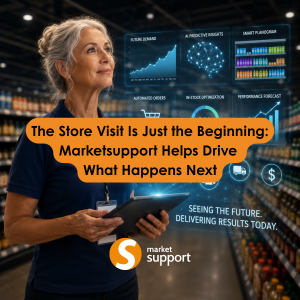 A merchandiser can accomplish a great deal during a store visit. Products can be moved from the stockroom to the sales floor, shelves can be replenished, inventory conditions can be assessed and issues affecting product availability can be identified. Once that merchandiser walks out of the store, however, the value of the visit should not disappear with them.
For brands managing products across a large retail network, one of the persistent challenges of field execution is visibility. It is relatively easy to know that a store was assigned and that a visit took place. It is much more valuable to understand what the field team encountered, what work was completed, where problems appeared and whether something discovered at store level requires further action.
Marketsupport’s investment in new operational technology is strengthening that connection between the work our in-store shelf stocking merchandisers perform and the information available to support the broader program.
The objective is not to turn every store visit into an exercise in collecting endless amounts of data. Retail organizations already have more information than they can reasonably use. The opportunity is to capture meaningful information from the field, connect it with program operations and create better visibility into what is actually happening where products meet consumers.
A store visit contains more information than a completion status
At its most basic level, retail merchandising reporting can answer a simple question: did someone visit the store and complete the assigned work?
That information is important because brands need accountability from their field partners. However, it represents only one dimension of the visit. A completed assignment does not necessarily tell a program manager what conditions the merchandiser encountered when they arrived.
The product may have been readily available in the back room and simply needed to be stocked. Inventory may have been lower than expected. A particular SKU may have been moving faster than others. The merchandiser may have encountered an issue that affected the amount of product that could be placed on the shelf. Another location in the same market may have presented a completely different situation.
Those differences are difficult to understand when field execution is viewed primarily as a collection of completed tasks.
A more connected approach allows the store visit to become a source of operational intelligence. The physical work remains the priority, but useful information generated while performing that work can contribute to a broader understanding of the program.
For clients, this means the people servicing their products can provide value beyond the immediate physical task they were assigned to complete.
The challenge gets bigger as the store network grows
Visibility becomes considerably more difficult as a merchandising program expands.
A manager responsible for a small number of locations may be able to stay closely involved with individual stores. That becomes unrealistic when a brand has products distributed across hundreds or thousands of locations and relies on a large field team to service them.
At that scale, management needs a way to understand the program without attempting to personally reconstruct every store visit. The challenge is creating enough visibility to identify what deserves attention while avoiding a reporting environment that overwhelms people with information.
Technology becomes important because it provides the infrastructure required to organize activity across a distributed workforce. Field information can be connected to specific locations and activities, giving operations teams a more structured view of execution across the program.
This is particularly relevant for outsourced merchandising. A manufacturer is placing part of its retail execution into the hands of another organization, so the quality of that relationship depends not only on whether the physical work gets done, but also on whether the manufacturer has confidence in how the program is being managed.
Better visibility can help create that confidence.
Seeing patterns instead of isolated store problems
One store experiencing an inventory issue may simply have a local problem. If the same issue begins appearing across numerous locations, the situation becomes much more significant.
This is where connected field information can become especially valuable.
When individual store observations remain isolated, organizations may be slower to recognize patterns developing across a market or retail network. A problem can appear insignificant when viewed one store at a time even though the combined field activity is telling a larger story.
Bringing information together makes it easier for operations teams to understand whether something is an exception or part of a recurring trend. That could involve product availability, inventory conditions, execution challenges or another issue affecting the program.
The goal is not for field data to replace sales information, retailer data or other business intelligence. Instead, it adds another perspective that is particularly valuable because it comes directly from people physically servicing the product.
A sales report can show what consumers purchased. Field execution can help provide context around what was happening at the shelf while those sales were occurring.
For manufacturers trying to understand performance across a complex retail environment, those perspectives can complement one another.
Accountability should mean more than proving someone was there
Technology has made it easier for field organizations to document activity, but accountability should go beyond confirming that a representative arrived at a location.
The more important question is whether the program is accomplishing what the client hired the field organization to achieve.
For Marketsupport, that begins with execution. Our in-store merchandisers are there to perform physical work, including shelf stocking and supporting the activities required to keep products available. Technology should strengthen our ability to manage that work rather than distract people from it.
A connected operational system gives managers a better foundation for understanding what is occurring across the field team. When issues arise, there is more context available to determine where attention may be required. When a program expands, the organization has infrastructure capable of supporting greater complexity without relying entirely on informal communication between individual representatives and managers.
This creates accountability at several levels. The individual store visit matters, but so does the performance of a territory, a region and the overall program.
For a client, that broader view can be far more useful than receiving a large collection of disconnected store reports.
Better information can improve the next store visit
Field visibility should not exist solely for executives reviewing reports. The information coming from stores can also help improve how the field program itself is managed.
If particular locations repeatedly require additional attention, operations teams can identify that pattern. If a recurring problem appears across several stores, managers can investigate whether the issue requires a broader response. If the needs of the program change over time, field resources and priorities can be adjusted accordingly.
This creates a feedback loop between execution and management. Store-level activity informs the operations team, and the operations team can use that information to improve future execution.
The benefit becomes increasingly important in retail environments where conditions change quickly. Product demand can fluctuate, retailer operations can change and individual locations can perform very differently even when they carry the same products.
A field program needs enough flexibility to respond to those differences. Having better visibility into what representatives are experiencing gives the organization a stronger foundation for making those adjustments.
Connecting the shelf with broader retail operations
Marketsupport’s expanded technology capabilities also create opportunities to connect field visibility with functions beyond the individual merchandising visit.
For example, information about store-level requirements can support ordering and inventory processes. In Direct Store Delivery programs, field representatives can take orders that move through Marketsupport’s system into the appropriate ordering workflow. In other types of programs, inventory and delivery management may also become part of the services being performed.
These capabilities matter because retail execution rarely exists in isolation. Shelf stocking depends on product being available. Replenishment depends on inventory. Inventory depends on ordering and distribution. Field teams interact with several points in that process because they are physically present where products are ultimately being sold or used.
The more effectively those activities can be connected, the more useful the field organization becomes to the manufacturer.
This does not mean every Marketsupport program needs to include every capability. A client may simply need reliable in-store shelf stocking across a specific retail network, while another may require a more complex program involving ordering, inventory or delivery.
The advantage of stronger operational infrastructure is the ability to support different levels of complexity while maintaining visibility across the work being performed.
More data is not automatically better data
As technology becomes more sophisticated, there is a temptation to measure everything that can possibly be measured. That can create impressive dashboards while making it harder for people to determine which information actually deserves their attention.
Marketsupport’s approach to technology is grounded in execution. Information should help us manage field programs more effectively, help our clients understand what is happening and support action when something requires attention.
For a retail program, the most useful information will depend on its objectives. A manufacturer focused heavily on on-shelf availability may care about different field observations than a company managing a complex DSD operation. A client launching into new retailers may have different priorities from an established brand servicing a mature store network.
The reporting and operational process should reflect those differences.
Technology is most valuable when it brings clarity to a complex operation rather than simply creating another place for information to accumulate.
Turning thousands of store visits into one clearer picture
A national or regional merchandising program is ultimately made up of individual moments happening in individual stores. A merchandiser stocks a shelf in one location while another representative encounters an inventory issue hundreds of kilometres away. Another store may require no intervention beyond the routine work scheduled for that visit.
Individually, each interaction may seem small. Together, they represent the actual execution of the brand’s retail strategy.
Marketsupport’s investment in technology allows us to bring more of those interactions into a connected operational environment. Our clients still receive the value of having real people physically servicing products in stores, but those visits can contribute to a much clearer understanding of what is happening across the overall program.
That distinction becomes increasingly important as manufacturers ask their field partners to take responsibility for more sophisticated retail operations. A partner needs to be capable of putting the right people into stores, but it also needs to know what is happening across those stores and have the infrastructure required to respond.
For Marketsupport, better visibility is ultimately about making the physical work we already do more valuable. When our merchandisers leave a store, the work they completed remains important, but so does what we learned while they were there.
Across hundreds or thousands of visits, that knowledge can help transform a collection of individual merchandising assignments into a field program that is easier to understand, manage and improve. For more information visit www.marketsupport.ca.
« Back to Blog